Creatine FAQ
THE
ULTIMATE CREATINE TEST
How Much Do You Really Know? |
| As one of the
most studied sports nutrition supplements around, everyone knows
everything about creatine, right? We all know creatine works. That much
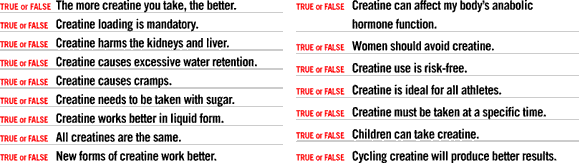
we can agree on. Take the following 16 question test and see how much
you know (or think you know) about creatine. |
 |
| Answers |
The
more creatine you take, the better. False
You’ve seen those mammoth bodybuilders chugging down 10-20 grams of
creatine at one sitting. Is it better to take more? No. According to
scientists at St. Francis Xavier University in Nova Scotia, at 0.1 grams
per kilogram of bodyweight, male athletes excreted 46% of the ingested
creatine within a period of 24 hours. For a 220 pound athlete, this
translates into about 10g of creatine. For the best results, try taking
half of this number for maximum value. In other words, if you weigh 220
pounds, take 5g of creatine per day. In another study performed at the
Human Performance Laboratory at Ball State University, scientists
confirmed that lower doses of creatine monohydrate (5g/day) are
effective. Better yet, the same results can be achieved without a
loading phase.
top of page
Creatine loading is mandatory. False
Once again, research is proving that less creatine is needed to
deliver results. The research cited above also suggests that creatine
loading may be nothing more than an expensive, wasteful proposition.
Should you load? In most cases, probably not. If you’re an elite
athlete, a professional bodybuilder, or competitive power lifter, you may
want to consider loading as an insurance policy. For the rest of us,
taking 3-5g of creatine daily should be just fine.
top of page
Creatine harms the kidneys and liver. False
Unless you have a pre-existing medical condition, no evidence
indicates that creatine use will damage your kidneys or liver. Most of
the hype has been the result of the media and anecdotal reports. In a
study that tracked healthy athletes over a five-year period, football
players who used creatine at levels of up to 15.75g per day showed no
effect on markers of renal or kidney stress. In another article,
researchers concluded that there was “no evidence for deleterious
effects in healthy individuals.” In one study conducted by Dr. Kerry
Kuehl at the Oregon Health Sciences University in Portland and presented
at the 2000 annual meeting of the American College of Sports Medicine,
the kidney function of 36 healthy male and female athletes who consumed
10g of creatine per day was examined. After twelve weeks, Dr. Kuehl
found that creatine did not adversely affect kidney function.
top of page
Creatine causes excessive water retention. False
This is purely speculative. In fact, a recent clinical study
cited in Physical Magazine (March 2001) actually examined this subject.
Results of a double blind, placebo-controlled study found that, after
three months of creatine use, test subjects showed no significant
increase in body water. In fact, the creatine group showed greater gains
in total body mass and fat-free mass. This recent study employed the
latest in body composition measurements–deuterated water isotopic
analysis, which uses a non-radioactive “tracer.” While it is
possible that some inferior-grade creatine may actually promote water
gain that results in a soft, puffy look, this can be due to several
reasons. One, it may not be due to the creatine, but excess sodium. When
cheaply manufactured, excess sodium remains in the finished product.
Naturally, eating foods rich in salt will cause water retention. Once
again, be sure to ask where your creatine is being manufactured. If your
creatine product is high in sugar, it’s possible that these carbs will
add to an overall soft look as well. Finally, bear in mind that muscle
is 75% water. With creatine use, if you gain lean mass, you gain water
weight. No surprise.
top of page
Creatine causes cramps. False
The belief that creatine use causes muscle cramping is anecdotal
with no clinical evidence to support this claim. On the contrary,
clinical studies show that creatine use is not associated with cramping.
In one study, researchers examined 16 men who either supplemented with
creatine or a placebo. Under specific dehydration conditions, the
occurrence of cramping and tightness were reported in both groups, but
“nothing that would suggest a greater incidence associated with
creatine supplementation.” Two other studies conducted at Arkansas
State University in Jonesboro found that creatine use by 61 Division I
athletes during training camps had no effect on the incidence of muscle
cramps, injury, or illness. These athletes used 15-25g per day on the
loading phase and another 5g per day as maintenance.
top of page
Creatine needs to be taken with sugars. False
The idea behind taking creatine with sugar, such as grape juice, is
sound, but bear in mind that the trick is not the grape juice per se.
For creatine uptake to be enhanced, insulin release should be
encouraged. Insulin functions as a kind of creatine “pump,” pushing
creatine into muscles. If you don’t mind the excess sugar, then try to
get at least 100-150 g of juice for every 5 g of creatine. Depending on
your level and your goals though, juice loaded with sugars may not be
suitable. Newer research indicates that you Newer research indicates
that you can take your creatine with protein for the same results. A new
study reports that taking 5g of creatine with 50g of protein/47g of
carbs produced the same results as taking 5g of creatine with 96g of
carbs. Therefore, creatine-based products, such as LAVA
with a 1:1 ratio
of carbs to protein, may be more suitable for bodybuilders than
sugar-based creatine supplements.
top of page
Creatine works better in liquid form. False
In liquid form, you may not even be getting creatine, but creatinine,
a by-product of creatine breakdown. Creatine, in powder form, is
extremely stable. When exposed to an acidic environment or moisture for
a long time, it will begin to break down. In other words, creatine
drinks, serums, and various other liquids should be avoided, as the
preservatives (e.g., citric acid, phosphoric acid) used in those drinks
are acidic. Shelf life on these products may be several weeks at most.
Unless you know when the product was bottled, you have no idea how much
creatine you’re actually getting. New technology is on the horizon for
stabilized creatine liquid products, but for now, stick with the powder.
Also, if you’re going to premix creatine into your favorite protein or
meal replacement beverage, try to consume the entire shake by the end of
the day.
top of page
All creatines are the same. False
Just as there is a difference between $250 champagne and $25
champagne, there’s a difference between high-quality creatine and
inferior-grade creatine. Traditionally, Chinese creatine is a lower
quality product, with more contaminants such as creatinine, sodium,
dicyandiamide, and dihydrotriazine. German creatine is rated to be the
world’s best.
top of page
New forms of creatine work better. False
News flash: No form of creatine has been proven in published
clinical studies to work better than plain old creatine monohydrate
powder. Creatine monohydrate is not glamorous, but it works. Remember,
whether you’re spending your extra dollar on effervescent, liquid, or
chewable creatine, the most important consideration is the creatine. If
you decide to splurge and buy creatine citrate or creatine phosphate,
remember one thing: the major clinical studies have been performed on
plain creatine monohydrate powder. Many studies have also shown that the
body easily assimilates creatine powder. So unless you’ve got money to
burn (and waste), stick with creatine monohydrate powder.
top of page
Creatine can affect my body’s anabolic hormone
function. False
While creatine can boost strength, performance, and lean mass,
research from the University of Leuven in Belgium has shown that it
doesn’t alter anabolic hormone response to training. These hormones
included growth hormone, testosterone, and cortisol. This research also
might suggest that stacking creatine with prohormones or
GH
secretagogues might be beneficial.
top of page
Women should avoid creatine. False
As creatine, a natural substance found in foods such as fish and
meat, doesn’t affect anabolic hormone function, women who train with
intensity could benefit from creatine use. One study published in the
Journal of Strength and Conditioning Research found that women could
gain strength and reduce bodyfat with creatine use. In the study, 16
collegiate women lacrosse players loaded up with 20g of creatine and
followed up with 2g for maintenance for a period of 5 weeks. At the end
of the experiment, the creatine users significantly improved upper-body
strength, while simultaneously decreasing the percent of body fat. The
study also found no incidence of liver or kidney malfunction, as
measured by blood metabolites during the five weeks. Since creatine
doesn’t affect or alter anabolic hormone function, creatine won’t
“turn women into men.”
top of page
Creatine use is risk-free. False
Although creatine is non-toxic, creatine use is not wholly
risk-free. As with all nutritional supplements, individuals with
pre-existing medical conditions should not take creatine or other sports
supplements. For example, there has been at least one case study that
reported kidney inflammation in subjects who used creatine. However, in
one particular case, the patient had a pre-existing kidney problem. So
before you begin supplementing with anything, the best advice is to see
your physician.
top of page
Creatine is ideal for all athletes. False
Some athletes stand to benefit a great deal, others very little.
Athletes who require sudden, high intensity bursts of power and strength
are ideal candidates for creatine supplements. These athletes might
include power lifters, bodybuilders, sprinters, and football, baseball,
and basketball players. Endurance athletes or those who participate in
sports which require steady aerobic output may not benefit as much from
creatine use.
top of page
Creatine must be taken at a specific time. False
It has been proven that you can maximize creatine uptake by taking
it with a 1:1 ratio of protein to carbs, but no real evidence suggests
that there’s a best time to take creatine. As a supplement, creatine
increases your body’s pool of creatine. Whether you take it in the
morning, afternoon, or evening probably won’t make a significant
difference. For convenience sake, you might take it with your
post-training protein/carb shake.
top of page
Children can take creatine. False
While creatine is completely safe from a toxicity point of view, no
studies have been performed on creatine safety and supplementation with
respect to children. Therefore, creatine is not recommended for any
individual under the age of 18. The best way for young athletes to get
creatine would be to eat foods high in creatine (e.g., fish and red
meat).
top of page
Cycling creatine will produce better results. False
There’s no significant evidence that shows cycling creatine is
better than taking it continuously. There’s no compelling proof which
shows that creatine supplementation in athletes will down-regulate the
body’s own ability to produce creatine.
top of page
SOURCES
•Brenner M, et al. The effect of creatine supplementation during
resistance training in women. J Strength Cond Res 2000;14(2):207-213.
•Burke DG, et al. The effect of 7 days of creatine supplementation on
24-hour urinary creatine excretion. J Strength Cond Res
2001;15(1):59-62.
•Eijnde B, et al. Med Sci Sports Exerc 2001;33:449-453.
•Greenhaff PL, Steenge GR, Simpson EJ. Protein and
carbohydrate-induced augmentation of whole body creatine retention in
humans. J Appl Physiol 2000;89:1165-71.
•Guerrero-Ontiveros ML, Walliman T. Creatine supplementation in health
and disease. Effects of chronic creatine ingestion in vivo:
down-regulation of the expression of creatine transporter isoforms in
skeletal muscle. Mol Cell Biochem 1998;184:427-437.
•Poortmans JR, et al. Long-term oral creatine supplementation does not
impair renal function in healthy athletes. Med Sci Sports Exer
1999;31(8):1108-10.
•Poortmans JR, Francaux M. Adverse effects of creatine
supplementation. Sports Med 2000;30: 155-170.
•Vogel RA, et al. Creatine supplementation: effect on supramaximal
exercise performance at two levels of acute hypohydration. J Strength
Cond Res 2000;14(2):214-219. |
Copyright © 1999 Universal
Nutrition. All
rights reserved.
|